The Menstrual Cycle and Sport Performance: Why an Individualised Approach Matters
2 September 2026
Understanding how an athlete’s menstrual cycle may influence training and performance can help athletes and coaches make informed decisions that best support performance and wellbeing.
Disclaimer: This article is intended for general information only and does not replace medical advice. For individualised support, consult a medical doctor or sport physiologist.
Understanding how the menstrual cycle may influence training and performance has become an increasingly important topic in high performance sport. While many female athletes wonder whether they should adjust their training around different phases of their cycle, current evidence suggests that there is no universal answer.
Instead, the best approach is one that recognises every athlete's experience is unique. By understanding individual patterns and managing symptoms proactively, athletes and coaches can make informed decisions that best support performance and wellbeing.
Understanding the Menstrual Cycle
The menstrual cycle is a natural, repeating process that typically lasts between 21 and 35 days. Throughout the cycle, the body's ovarian hormones—oestrogen and progesterone—rise and fall as the body prepares for a potential pregnancy.
The cycle can be broadly divided into two main phases:
Follicular phase: The first half of the cycle, before ovulation.
Luteal phase: The second half of the cycle, after ovulation.
Two key events occur during the cycle:
Menstruation (Period)
This marks the beginning of a new cycle, when the lining of the uterus is shed because pregnancy has not occurred.
Ovulation
Usually occurring around the middle of the cycle, ovulation is when an egg is released from the ovary.
Understanding these hormonal fluctuations provides important context for discussing how the menstrual cycle may relate to sport performance.
Does the Menstrual Cycle Affect Sport Performance?
Oestrogen and progesterone influence many systems within the body, leading researchers to explore whether hormonal changes across the menstrual cycle affect athletic performance.
While this is an active area of research, the current scientific evidence remains inconclusive.
Studies have reported mixed findings, with considerable variation both between studies and between individual athletes. At present, there is no strong evidence that athletes should routinely modify their training according to a specific phase of the menstrual cycle, nor that performance will consistently improve or decline at certain times.
Every Athlete is Different
One of the strongest messages emerging from current research is that the relationship between the menstrual cycle and performance is highly individualised.
Some athletes may notice clear changes in how they feel or perform during different phases of their cycle, while others experience little to no noticeable difference. Rather than assuming that every athlete responds the same way, it is more helpful to understand each individual's own experience.
Menstrual Symptoms Can Influence Training
Although research is less clear on the direct impact of hormonal changes on performance, many athletes do experience menstrual symptoms that can affect their training.
Common symptoms include:
Abdominal cramps
Sleep disturbances
Irritability
For many athletes, symptoms are most noticeable:
During Days 1 to 3 of menstruation, and
In the days leading up to the start of their period.
The severity, type and timing of symptoms vary widely from person to person. While some athletes train and compete with minimal disruption, others may find symptoms significantly affect their physical comfort, recovery or readiness to perform.
Recognising these symptoms and addressing them early can help minimise their impact on both training and competition.
An Individualised Approach to Performance
Because no two athletes experience the menstrual cycle in exactly the same way, an individualised approach is recommended.
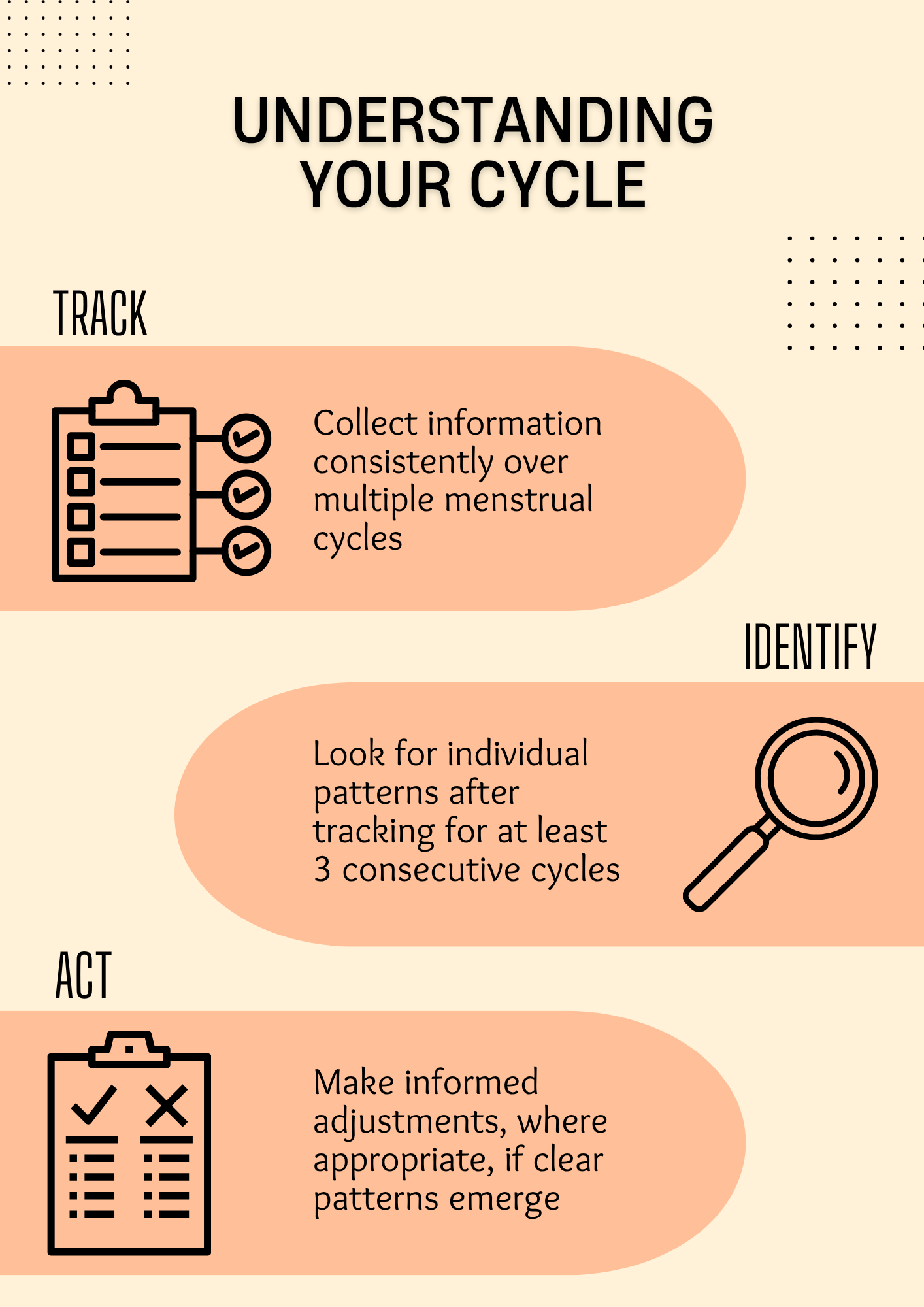
A simple framework is to Track, Identify and Act.
1. Track
Collect information consistently over multiple menstrual cycles, including:
The first day of each menstrual cycle
Length of the menstrual cycle
Number of bleeding days and menstrual flow
Menstrual symptoms, including their type, severity and timing
Performance-related information such as training quality, recovery and overall wellness
Consistent tracking provides valuable information that can reveal meaningful patterns over time.
2. Identify
After tracking for at least three consecutive menstrual cycles, review the information to look for trends.
Consider questions such as:
Do symptoms regularly occur at certain times in the cycle?
Are there periods when training consistently feels easier or more challenging?
Does recovery change during certain phases?
It is equally important to remember that finding no clear pattern is also valuable information. Not every athlete's performance is influenced by their menstrual cycle.
3. Act
If clear patterns emerge, athletes and coaches can work together to make informed adjustments where appropriate.
These may include:
Modifying training intensity during periods of more severe symptoms
Planning additional recovery strategies
Adjusting session timing where practical
Implementing symptom management strategies in consultation with healthcare professionals
The aim is not to reduce training unnecessarily, but to support consistent performance while maintaining athlete health and wellbeing.
Key Takeaways
The menstrual cycle is an important aspect of female athlete physiology, but its relationship with sport performance is complex.
Current research suggests:
There is no one-size-fits-all approach to training around the menstrual cycle.
Scientific evidence does not currently support routine changes to training based solely on menstrual cycle phase.
Menstrual symptoms, rather than hormonal fluctuations alone, may influence training and performance for some athletes.
Tracking menstrual cycles, symptoms and performance over time helps athletes better understand their own individual responses.
Decisions about training should be based on personal patterns rather than general assumptions.
By taking an evidence-informed and individualised approach, athletes, coaches and support teams can better support both performance and long-term athlete wellbeing.
Explore more sport science support
HPSI's Sport Science team works with athletes and coaches across areas such as physiology, nutrition, psychology, biomechanics and performance analysis.